
Complete Guide (All 50 States)
Three months ago, Jennifer thought she was being smart.
She found a “living trust template” online for $29 and filled it out herself. The template looked professional, had all the right legal language, and seemed perfect for her situation.
There was just one problem: The template was designed for California law. Jennifer lives in Florida.
When Jennifer’s attorney reviewed the document, he delivered devastating news: “This trust is completely invalid in Florida. It won’t protect your family at all.”
The cost of her mistake: $29 template + $3,200 to fix it = $3,229
The lesson: State laws matter. A lot.**
Why State Laws Can Make or Break Your Trust
[IMAGE: Gavel with “STATE LAW VARIES” text and confused person looking at documents]

Here’s what most people don’t understand: Living trusts aren’t governed by federal law—they’re governed by state law.
And state laws vary dramatically.
What works in Texas might be invalid in New York. What’s required in California might be illegal in Florida. What’s optional in Nevada might be mandatory in Illinois.
The stakes are high: Get it wrong, and your trust could be:
•Completely invalid
•Partially unenforceable
•Subject to expensive legal challenges
•Unable to avoid probate (defeating the whole purpose)
The 5 Critical Areas Where States Differ
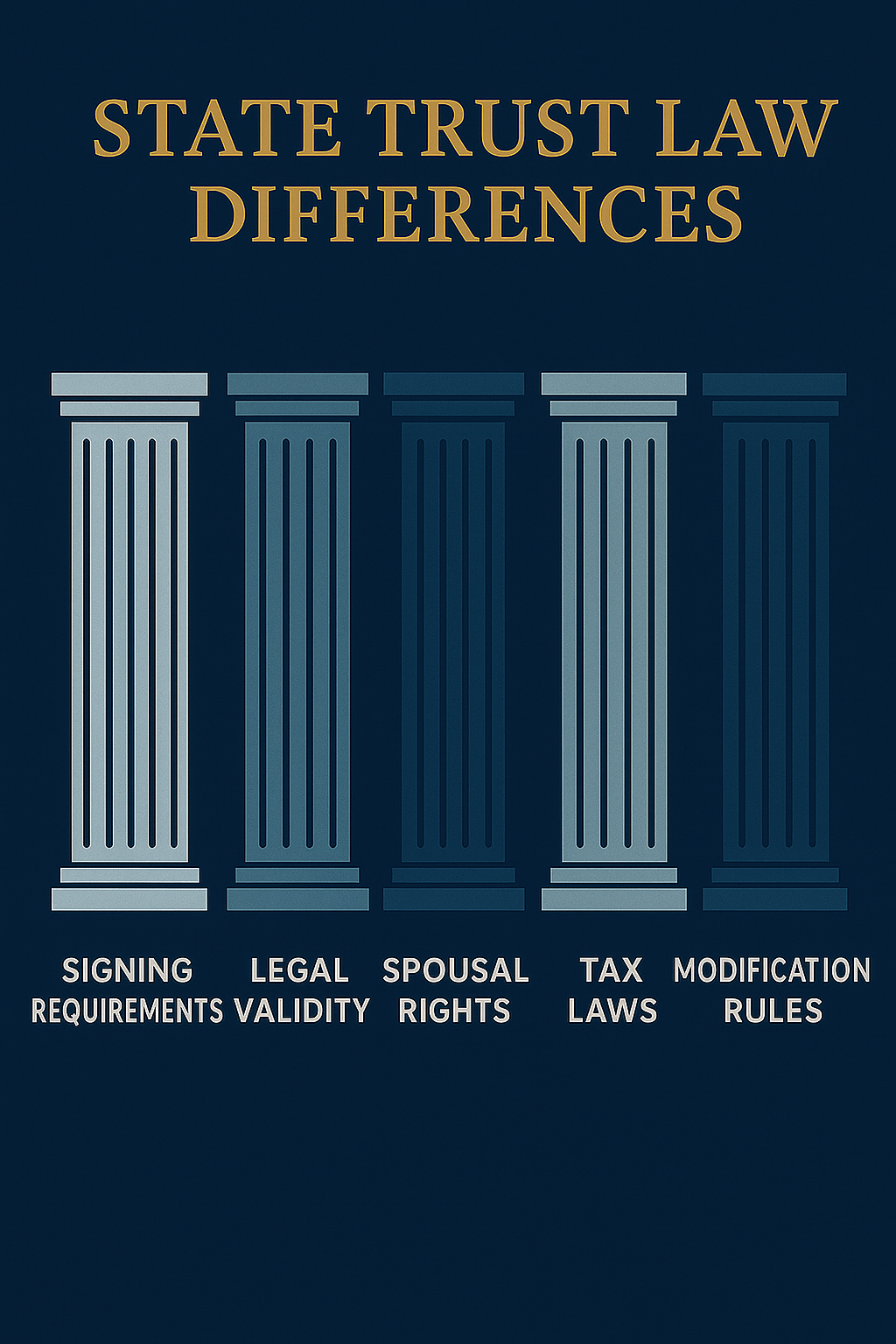
1. Witness and Notary Requirements
States with NO witness requirement:
•California, Nevada, Arizona, Texas (notary only)
States requiring 2 witnesses:
•Florida, New York, Pennsylvania, Ohio
States requiring 2 witnesses + notary:
•Illinois, Michigan, Georgia, North Carolina
Special cases:
•Louisiana: Requires 2 witnesses + notary + specific French civil law language
•Vermont: Allows self-proving affidavits to eliminate witness requirements
2. Spousal Protection Laws
“SPOUSAL RIGHTS PROTECTED” shield]

Community Property States (special rules):
•Arizona, California, Idaho, Louisiana, Nevada, New Mexico, Texas, Washington, Wisconsin
Elective Share States (surviving spouse can claim portion):
•Most other states allow surviving spouse to claim 1/3 to 1/2 of estate
No Spousal Protection States (rare):
•Georgia (with proper documentation)
Real impact: In New York, your spouse can claim up to 50% of your estate even if your trust says otherwise. In Texas, they might have no claim at all.
3. Homestead Exemptions
Unlimited Homestead Protection:
•Florida: Primary residence fully protected from creditors
•Texas: Unlimited rural, $125K urban protection
•Iowa: Unlimited protection
Limited Homestead Protection:
•California: $75K-$175K depending on age/disability
•New York: $170,000 in most counties
No Homestead Protection:
•Delaware, Maryland, New Jersey, Pennsylvania
Why this matters: Your trust needs different asset protection strategies depending on your state’s homestead laws.
4. Trust Administration Rules
[IMAGE: Courthouse with “TRUST ADMINISTRATION” sign and varying state flags]
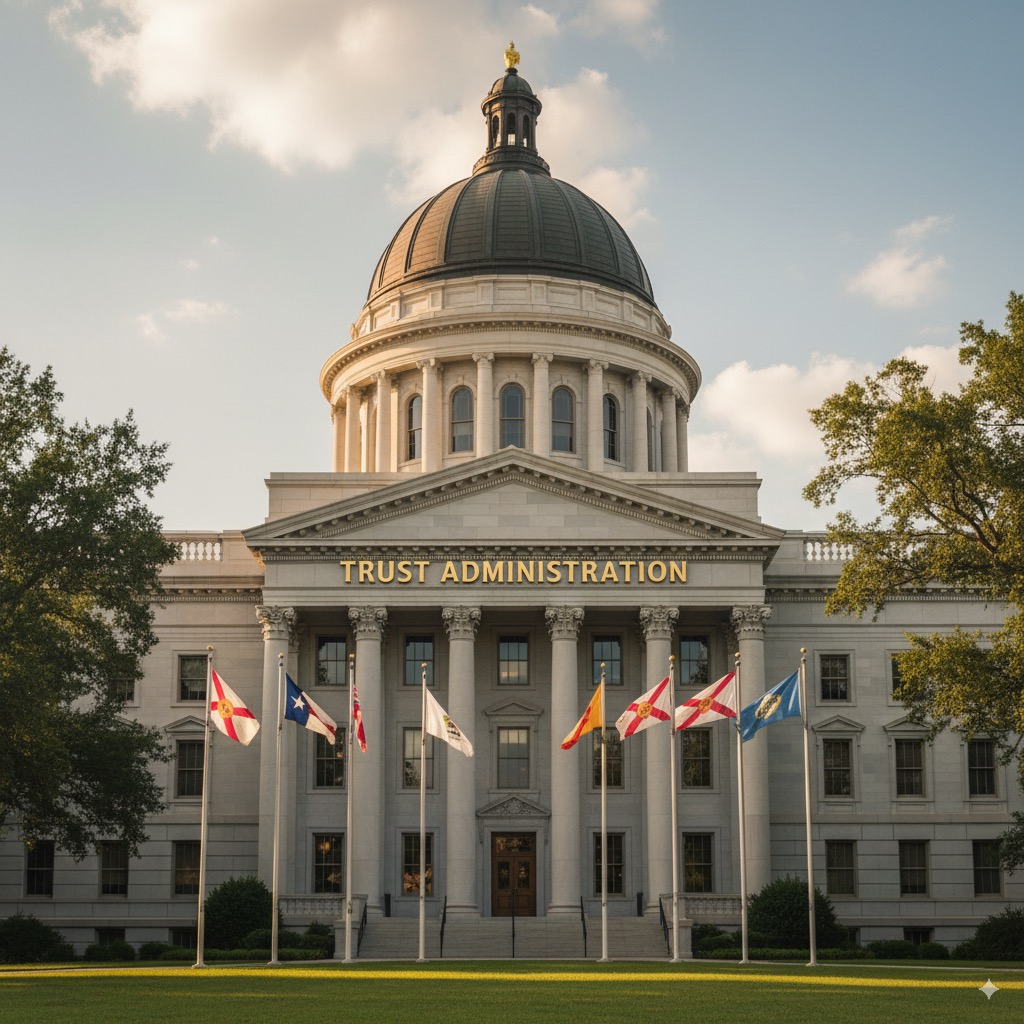
Strict Supervision States:
•New York: Requires court approval for many trustee actions
•Pennsylvania: Mandatory accountings to beneficiaries
Flexible Administration States:
•Nevada: Minimal court oversight, trustee-friendly
•Delaware: Business-friendly trust administration
Moderate Supervision States:
•California: Balanced approach, reasonable requirements
•Texas: Moderate oversight, practical rules
5. Tax Implications
No State Income Tax (trust-friendly):
•Alaska, Florida, Nevada, New Hampshire, South Dakota, Tennessee, Texas, Washington, Wyoming
High State Income Tax (trust-unfriendly):
•California (13.3%), New York (8.82%), New Jersey (10.75%)
Special Trust Tax Rules:
•Pennsylvania: No tax on trust income distributed to beneficiaries
•California: Complex rules for out-of-state trusts
State-by-State Breakdown (The Complete Guide)
[IMAGE: Detailed state-by-state comparison chart]
High-Complexity States (Extra Care Required)
CALIFORNIA
•Witnesses: Not required (notary sufficient)
•Spousal Rights: Community property state
•Homestead: $75K-$175K protection
•Special Requirements: Specific language for community property
•Tax Impact: High state income tax (13.3%)
•Probate Alternative: $184,500 threshold for simplified probate
NEW YORK
•Witnesses: 2 witnesses required
•Spousal Rights: Elective share (50% of estate)
•Homestead: $170,000 in most counties
•Special Requirements: Strict execution formalities
•Tax Impact: High state income tax (8.82%)
•Probate Alternative: $50,000 threshold for small estate
FLORIDA
•Witnesses: 2 witnesses + notary required
•Spousal Rights: Elective share (30% of estate)
•Homestead: Unlimited protection for primary residence
•Special Requirements: Self-proving affidavit recommended
•Tax Impact: No state income tax
•Probate Alternative: $75,000 threshold for summary administration
ILLINOIS
•Witnesses: 2 witnesses + notary required
•Spousal Rights: Elective share (50% of estate)
•Homestead: $15,000 protection
•Special Requirements: Specific witness qualifications
•Tax Impact: 4.95% state income tax
•Probate Alternative: $100,000 threshold for small estate
Moderate-Complexity States
TEXAS
•Witnesses: Not required (notary sufficient)
•Spousal Rights: Community property state
•Homestead: Unlimited rural, $125K urban
•Special Requirements: Community property considerations
•Tax Impact: No state income tax
•Probate Alternative: $75,000 threshold for muniment of title
ARIZONA
•Witnesses: Not required (notary sufficient)
•Spousal Rights: Community property state
•Homestead: $150,000 protection
•Special Requirements: Community property language
•Tax Impact: 2.59-4.5% state income tax
•Probate Alternative: $100,000 threshold for informal probate
OHIO
•Witnesses: 2 witnesses required
•Spousal Rights: Elective share (varies)
•Homestead: $145,425 protection
•Special Requirements: Witness age restrictions
•Tax Impact: No state income tax on trusts
•Probate Alternative: $100,000 threshold for summary release
Trust-Friendly States (Easier Requirements)
NEVADA
•Witnesses: Not required (notary sufficient)
•Spousal Rights: Community property state (but flexible)
•Homestead: $605,000 protection
•Special Requirements: Minimal formalities
•Tax Impact: No state income tax
•Probate Alternative: $300,000 threshold for set-aside
DELAWARE
•Witnesses: Not required (notary sufficient)
•Spousal Rights: Elective share (but waivable)
•Homestead: No homestead exemption
•Special Requirements: Business-friendly rules
•Tax Impact: No state income tax on trusts
•Probate Alternative: $30,000 threshold for small estate
The Costly Mistakes People Make
[IMAGE: Warning signs with dollar amounts showing costs of state law mistakes]

Mistake #1: Using Wrong State’s Template
Real case: Michigan resident used California template Result: Trust invalid, $4,200 to recreate properly Lesson: Always use your state’s requirements
Mistake #2: Ignoring Witness Requirements
Real case: Florida trust with only notary (no witnesses) Result: Trust challenged in court, $15,000 in legal fees Lesson: Follow your state’s execution requirements exactly
Mistake #3: Missing Spousal Protection Laws
Real case: New York trust that tried to disinherit spouse Result: Spouse claimed elective share, family lost $200,000 Lesson: Understand your state’s spousal rights laws
Mistake #4: Ignoring Community Property Rules
Real case: Texas couple treated separate property as community property Result: Unintended tax consequences, $25,000 additional taxes Lesson: Community property states have special rules
Mistake #5: Wrong Tax Planning
Real case: California trust that didn’t consider state taxes Result: $30,000 in unnecessary state income taxes Lesson: State tax laws affect trust planning
How AI Solves the State Law Problem
[IMAGE: AI robot with state flags and legal documents]
Here’s the game-changer: Modern AI can be trained on all 50 states’ trust laws and create compliant documents for your specific state.
Traditional approach:
•Find local attorney familiar with state law
•Pay $3,000-$6,000 for state-compliant trust
•Hope they stay current on law changes
AI approach:
•Use state-specific prompts trained on current law
•Generate compliant documents in minutes
•Update easily when laws change
•Cost: $50-$500 vs $3,000-$6,000
State-Specific AI Prompts That Work
For California residents:
Plain Text
I need you to act as an experienced California estate planning attorney creating a revocable living trust that complies with California Probate Code. CONTEXT: I am a [age]-year-old California resident with [marital status]. My assets include [list assets]. I want to avoid California probate and minimize state income taxes. INSTRUCTION: Create a California-compliant living trust that includes: – Proper California execution requirements (notary, no witnesses needed) – Community property considerations if married – California-specific tax planning language – Compliance with California Probate Code Section 15200-15209 – Homestead exemption optimization – California pour-over will coordination Ensure all language complies with current California law.
For Florida residents:
Plain Text
I need you to act as an experienced Florida estate planning attorney creating a revocable living trust that complies with Florida Statutes Chapter 736. CONTEXT: I am a [age]-year-old Florida resident with [marital status]. My assets include [list assets]. I want to avoid Florida probate and protect my homestead exemption. INSTRUCTION: Create a Florida-compliant living trust that includes: – Proper Florida execution requirements (2 witnesses + notary) – Self-proving affidavit language – Florida homestead protection optimization – Elective share considerations if married – Compliance with Florida Trust Code – Florida-specific asset protection strategies Ensure all language complies with current Florida Statutes.
Your State-Specific Action Plan
[IMAGE: Checklist with state-specific requirements]
Step 1: Identify Your State’s Requirements
Research these key areas:
•Witness and notary requirements
•Spousal protection laws
•Homestead exemptions
•Trust administration rules
•State tax implications
Step 2: Use State-Specific Resources
Don’t use generic templates. Use resources designed for your state:
•State-specific AI prompts
•Local attorney review
•State bar association resources
Step 3: Stay Current on Law Changes
State laws change. Make sure your trust stays compliant:
•Annual review of state law changes
•Update trust when laws change
•Monitor court decisions affecting trusts
Step 4: Consider Multi-State Issues
If you have property in multiple states:
•Each state’s laws may apply to property in that state
•Consider separate trusts for different states
•Plan for potential conflicts between state laws
Get Your State-Specific Trust System
[IMAGE: Book cover with “ALL 50 STATES COVERED” badge]
Ready to create a trust that actually works in your state?
My complete “Create Your Living Trust Using AI” system includes:
✅ State-specific requirements for all 50 states ✅ Customized AI prompts for each state’s laws ✅ Witness and notary requirement guides ✅ Spousal protection law summaries ✅ State tax planning strategies ✅ Multi-state property guidance ✅ Annual law change updates
Don’t risk your family’s security with generic templates.
Get state-compliant protection that actually works.
The Bottom Line
[IMAGE: US map with “PROTECTED” shield covering all states]
Your living trust is only as good as its compliance with your state’s laws.
Generic templates are gambling with your family’s future.
State-specific planning is protecting your family’s security.
The choice is obvious.
[GET YOUR STATE-SPECIFIC TRUST SYSTEM HERE →]
P.S. Not sure about your state’s specific requirements? I’ve created a free state law lookup tool that gives you the key requirements for your state in under 60 seconds.
[CHECK YOUR STATE’S REQUIREMENTS NOW →]
What’s the most confusing thing about your state’s trust laws? Drop a comment with your state and I’ll clarify the requirements for you personally.
Because your trust needs to work in YOUR state, not just any state.