
Last month, I got a call that broke my heart.
Sarah, a 52-year-old teacher from Phoenix, was sobbing on the phone. Her husband had just passed away suddenly, and she discovered their “living trust” was completely worthless. They’d paid $3,200 to a lawyer three years ago, but he never helped them actually fund the trust.
Now? Sarah’s house was stuck in probate. Her bank accounts were frozen. And her teenage kids were asking why they couldn’t access Dad’s life insurance money.
Here’s the brutal truth: Most living trusts fail not because they’re poorly written, but because of simple mistakes that could’ve been avoided.
I’ve seen families lose tens of thousands of dollars—sometimes their entire inheritance—because of these five critical errors. The good news? Every single one is preventable if you know what to look for.
Mistake #1: Creating a “Zombie Trust” (The $50,000 Error)
What it is: You create a beautiful trust document, sign it with a notary, file it away… and never transfer a single asset into it.
Real cost: Everything goes through probate anyway. You’ve essentially bought expensive wallpaper.
I call these “zombie trusts” because they look alive on paper but are completely dead in practice. And they’re everywhere.
The numbers are staggering:
•73% of living trusts are never properly funded
•Average probate cost in California: $50,000+ for a $500,000 estate
•Time stuck in probate: 12-18 months minimum
Sarah’s story continued: Her husband’s trust was perfectly written. It had all the right legal language, proper successor trustees, even tax optimization strategies. But their house, bank accounts, and investment portfolio? Still in their individual names.
How AI fixes this: Modern AI prompts can generate step-by-step funding checklists customized to your exact assets. No more guessing what needs to be transferred or how to do it.
AI Prompt Example: “I need a complete asset transfer checklist for my living trust. I own: [list your assets]. Generate specific instructions for each item, including which forms I need and who to contact.”
Mistake #2: The “Set It and Forget It” Trap
What it is: Creating your trust once and never updating it, even when your life changes dramatically.
Real cost: Your trust becomes outdated and potentially invalid.
Here’s what happened to Mike, a business owner in Texas:
When Mike created his trust in 2015, he was single with no kids. Fast forward to 2023: he’s married, has two young children, sold his original business, and started a new one. His trust still names his brother as the primary beneficiary.
Life changes that require trust updates:
•Marriage or divorce
•Birth or adoption of children
•Death of beneficiaries or trustees
•Significant changes in assets
•Moving to a different state
•Changes in tax laws
The AI advantage: You can use AI to review your trust annually and identify what needs updating based on your current situation.
AI Prompt for Annual Review: “Review my living trust created in [year]. My current situation: [describe changes]. What provisions need updating and why?”
Mistake #3: Choosing the Wrong Successor Trustee (The Family Destroyer)
What it is: Picking someone who sounds good on paper but will be a disaster in real life.
Real cost: Family feuds, mismanaged assets, and expensive legal battles.
Let me tell you about the Johnson family disaster…
Robert Johnson thought he was being fair by naming his three adult children as co-trustees. Sounds reasonable, right?
Wrong.
When Robert passed away, his kids couldn’t agree on anything. Sell the family home or keep it? Invest conservatively or aggressively? One wanted to distribute everything immediately, another wanted to hold assets for grandchildren.
The result: Two years of legal battles, $80,000 in attorney fees, and a family that no longer speaks to each other.
Red flags for successor trustees:
•They live across the country (and hate to travel)
•They’re terrible with money
•They don’t get along with your beneficiaries
•They’re the same age as you (what if they die first?)
•They’re too busy to handle the responsibility
The AI solution: Use AI to evaluate potential trustees objectively, without family politics clouding your judgment.
AI Evaluation Prompt: “Help me evaluate [person’s name] as my successor trustee. They are [age], live in [location], work as [job], and have these qualities: [list]. What are the pros and cons?”
Mistake #4: DIY Disasters (When Cheap Becomes Expensive)
What it is: Using generic online forms or trying to create a trust without understanding your state’s specific requirements.
Real cost: Invalid documents, legal challenges, and complete trust failure.
I’m not against DIY—when done right. But I’ve seen too many horror stories.
Case study: Jennifer from Florida used a $49 online trust form designed for California. Florida has different witness requirements, different homestead laws, and different rules about trust administration.
When Jennifer’s trust was challenged in court, the judge ruled it invalid. Her family spent $35,000 in legal fees trying to fix a $49 mistake.
Common DIY mistakes:
•Using forms from the wrong state
•Incorrect witness or notary requirements
•Missing required language for tax benefits
•Improper asset titling instructions
•No provisions for digital assets
The AI advantage: AI can help you create state-specific trusts that actually comply with local laws, while still saving you thousands compared to attorney fees.
State-Specific AI Prompt: “I live in [state] and want to create a living trust. What are the specific legal requirements I must follow, including witness requirements, notary rules, and any unique state laws?”
Mistake #5: Ignoring the “What If” Scenarios
What it is: Creating a trust that works perfectly in ideal circumstances but falls apart when life gets messy.
Real cost: Unintended consequences that can destroy your family’s financial security.
The scenario nobody thinks about: What if you and your spouse die together? What if your chosen successor trustee becomes incapacitated? What if your beneficiary develops a drug problem?
Real example: Tom and Linda created a simple trust leaving everything to their adult son, Mark. They never considered that Mark might get divorced.
When Tom and Linda died in a car accident, Mark inherited $800,000. Six months later, Mark’s wife filed for divorce and claimed half of the inheritance as marital property.
Critical “what if” scenarios to address:
•Simultaneous death of spouses
•Beneficiary bankruptcy or divorce
•Successor trustee incapacity
•Minor children inheriting large sums
•Family business succession
•Special needs family members
AI scenario planning: Use AI to think through complex “what if” situations and build protections into your trust.
Scenario Planning Prompt: “I’m creating a living trust with these beneficiaries: [list]. Help me identify potential problems and ‘what if’ scenarios I should plan for, including specific trust provisions to address each risk.”
The Real Cost of These Mistakes
Let’s do the math on what these mistakes actually cost families:
Mistake #1 (Unfunded Trust):
•Probate costs: $30,000-$100,000+
•Time delay: 12-24 months
•Family stress: Priceless (and painful)
Mistake #2 (Outdated Trust):
•Legal challenges: $20,000-$50,000
•Unintended beneficiaries: Potentially everything
•Tax penalties: 10-40% of estate value
Mistake #3 (Wrong Trustee):
•Family legal battles: $50,000-$200,000
•Mismanaged assets: 20-50% loss in value
•Destroyed relationships: Irreplaceable
Mistake #4 (DIY Disasters):
•Invalid documents: Complete loss of benefits
•Court challenges: $25,000-$75,000
•Emergency legal fixes: $10,000-$30,000
Mistake #5 (No Contingency Planning):
•Unprotected assets: 25-50% loss to creditors
•Family disputes: $30,000-$100,000 in legal fees
•Unintended consequences: Potentially catastrophic
Total potential cost of these mistakes: $185,000-$555,000+
How AI Changes Everything
Here’s what’s different now: AI can help you avoid every single one of these mistakes for a fraction of what you’d pay an attorney.
The old way:
•Pay $3,000-$5,000 to a lawyer
•Hope they remember to tell you about funding
•Get generic advice that might not fit your situation
•No ongoing support or updates
The AI way:
•Use proven prompts to create customized documents
•Get step-by-step funding instructions
•Receive ongoing guidance for updates and changes
•Pay less than $50 for comprehensive guidance
But here’s the key: You need the right AI prompts. Generic questions get generic answers. Specific, well-crafted prompts get professional-quality results.
Your Next Steps (Don’t Wait)
If you already have a living trust, run through this checklist:
☐ Is your trust properly funded? (Check every asset) ☐ Have you updated it in the last 3 years? ☐ Is your successor trustee still the right choice? ☐ Does it comply with your current state’s laws? ☐ Have you planned for “what if” scenarios?
If you answered “no” or “I’m not sure” to any of these, you’ve got work to do.
If you don’t have a trust yet, stop procrastinating. Every day you wait is another day your family is at risk.
The Bottom Line
Sarah’s story doesn’t have to be your story.
With the right knowledge and tools, you can create a bulletproof living trust that actually works. You can avoid the mistakes that cost other families hundreds of thousands of dollars.
The choice is yours:
•Keep putting it off and hope nothing happens
•Pay $3,000+ to a lawyer and hope they do it right
•Use proven AI strategies to create professional results for a fraction of the cost
Ready to protect your family the smart way?
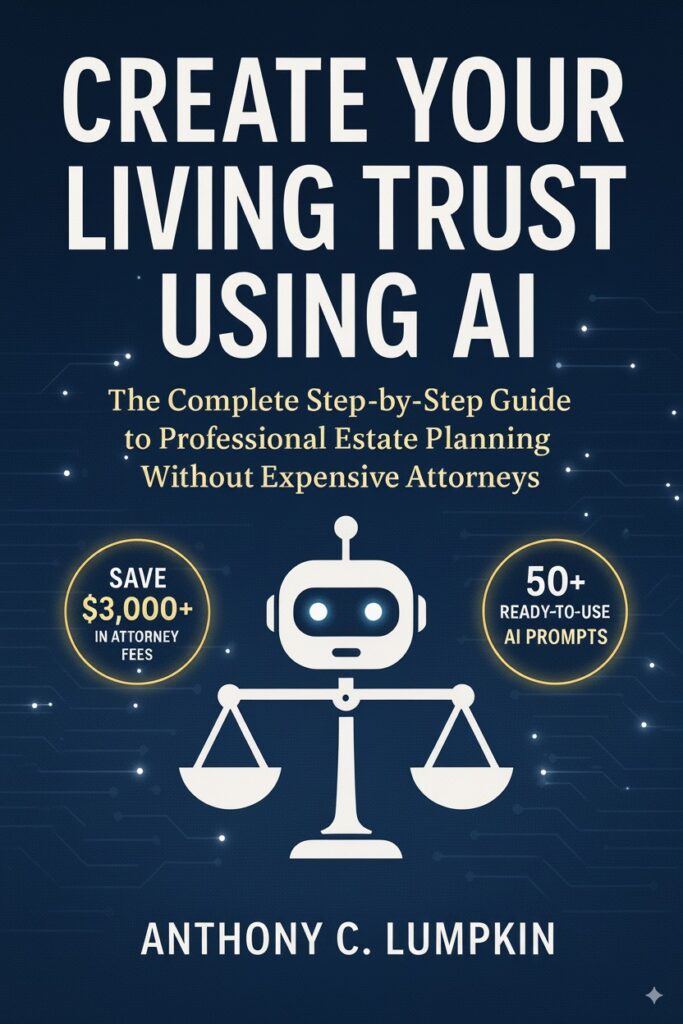
Get our complete “Create Your Living Trust Using AI” guide with 50+ proven prompts, state-specific requirements, and step-by-step instructions that ensure you avoid every mistake on this list.
[Get the Complete Guide Here →]
Because your family’s financial security is too important to leave to chance.
P.S. Still not convinced AI can handle something this important? I get it. That’s why our guide includes real examples, actual prompts that have been tested by estate planning attorneys, and a complete system that walks you through every step. You’re not just getting AI prompts—you’re getting a proven system that works.
What’s your biggest concern about creating a living trust? Drop a comment below and I’ll address it personally.