
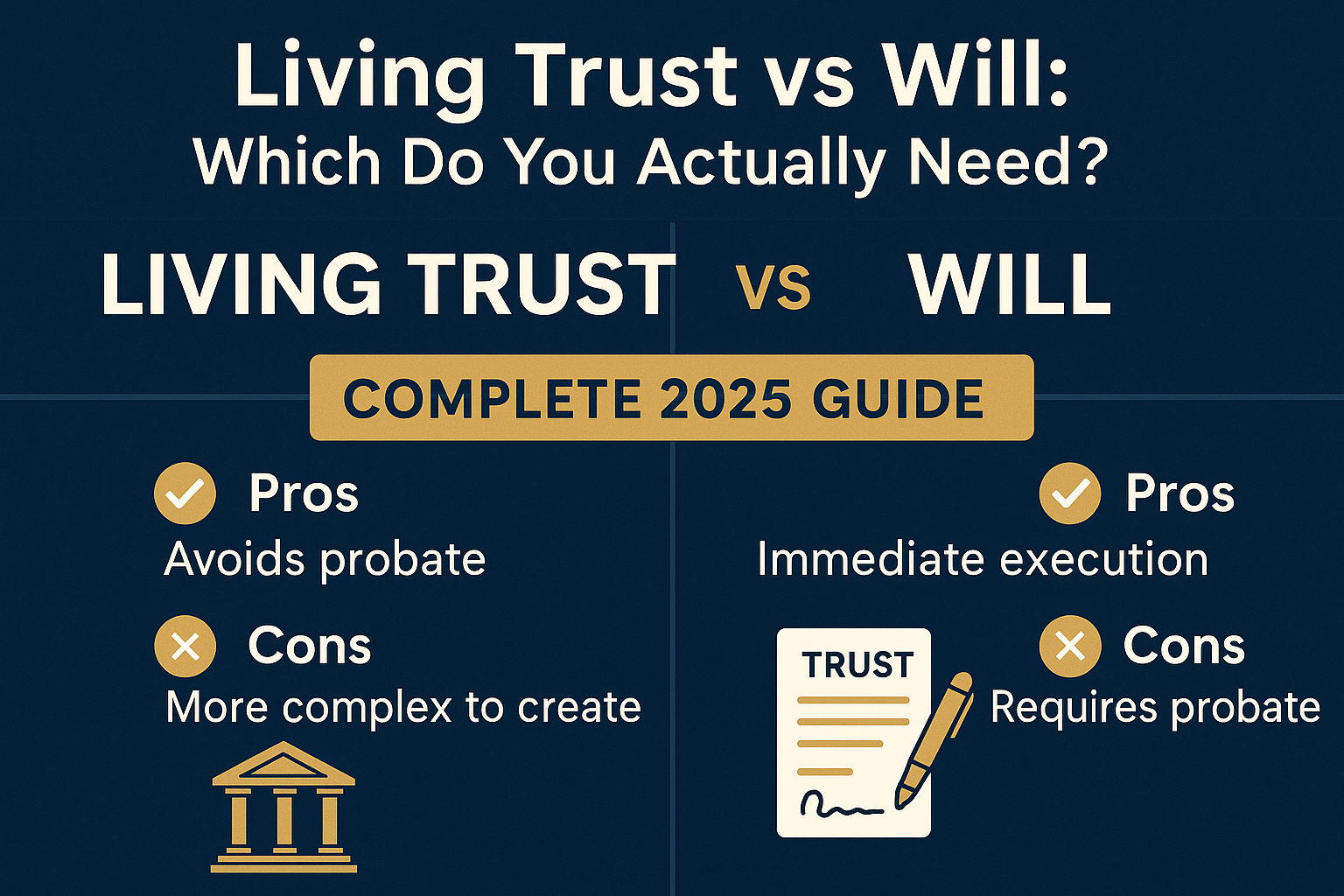
[IMAGE: Split-screen comparison showing “LIVING TRUST” vs “WILL” with pros/cons columns]
“Should I get a will or a living trust?”
I get this question at least five times a week. And every time, I give the same answer:
“It depends on whether you want to protect your family or just check a box.”
Here’s the brutal truth: Most people think a will is enough. They’re wrong.
Last month, I watched a family spend $47,000 and 18 months in probate court because they thought their “simple will” would handle everything.
Spoiler alert: It didn’t.
The $50,000 Mistake Most Families Make
[IMAGE: Courtroom scene with “PROBATE COURT” sign and stressed family]
Meet the Johnson family. Tom and Linda were smart people—both college-educated, successful careers, responsible parents.
They did what they thought was right: They got wills.
Their will said: “Everything goes to the surviving spouse, then to our kids.”
Simple, right?
When Tom died suddenly at 52, here’s what actually happened:
•Month 1-2: Linda couldn’t access Tom’s bank accounts (they were in his name only)
•Month 3-6: The house couldn’t be sold (stuck in probate)
•Month 7-12: Legal fees mounted as the court “supervised” the obvious
•Month 13-18: Finally resolved, but not before costing $47,000 in fees
The kicker? A living trust would have avoided all of this.
Living Trust vs Will: The Real Differences
[IMAGE: Detailed comparison chart with icons for each feature]
What Happens When You Die
With a Will:
1.Will goes to probate court
2.Judge validates the will (6-24 months)
3.Court supervises asset distribution
4.Everything becomes public record
5.Family pays court fees and attorney costs
6.Result: Expensive, slow, public process
With a Living Trust:
1.Successor trustee takes over immediately
2.Assets distributed according to trust terms
3.No court involvement needed
4.Everything stays private
5.Minimal costs and delays
6.Result: Fast, private, inexpensive process
Privacy Protection
[IMAGE: Public records vs private documents comparison]
Wills are public documents. Anyone can look up:
•How much you owned
•Who inherited what
•Family disputes and challenges
•Your personal financial details
Living trusts are private. Nobody knows:
•What assets you had
•Who your beneficiaries are
•How much anyone inherited
•Your family’s business
Real example: When a local business owner died with just a will, competitors used the public probate records to poach his clients by targeting his widow during her vulnerable time.
Cost Comparison (The Numbers Don’t Lie)
[
Will-Based Estate Plan:
•Initial cost: $800-$2,000
•Probate costs: $15,000-$100,000+
•Time delays: 6-24 months
•Total family cost: $15,800-$102,000
Living Trust-Based Plan:
•Initial cost: $2,500-$5,000 (attorney) or $50-$500 (AI-assisted)
•Probate costs: $0
•Time delays: 0-30 days
•Total family cost: $50-$5,000
Savings with living trust: $10,000-$97,000
When a Will is Actually Enough (Rare Cases)
[IMAGE: Simple stick figure family with minimal assets]
Don’t get me wrong—wills aren’t always bad. They work fine if:
✅ You have minimal assets (under $50,000 total) ✅ You rent instead of own (no real estate) ✅ You have simple family structure (married with adult kids, no complications) ✅ You live in a will-friendly state (few exist) ✅ You don’t mind your family dealing with probate
Reality check: This describes maybe 5% of American families.
When You Absolutely Need a Living Trust
[IMAGE: Checklist with red checkmarks for urgent situations]
You need a living trust if you have ANY of these:
🏠 Real estate (even just your primary home) 💰 Assets over $100,000 (including retirement accounts) 👨👩👧👦 Minor children (they can’t inherit directly) 💼 Business ownership (any percentage) 🏖️ Property in multiple states (avoid multiple probates) 💔 Blended family (yours, mine, and ours situations) 🎯 Privacy concerns (don’t want finances public) ⏰ Want to avoid delays (family needs immediate access to funds)
If you checked even one box, you need a living trust.
The Myths That Cost Families Thousands
[IMAGE: “MYTH BUSTED” graphic with common misconceptions crossed out]
Myth #1: “Wills are simpler”
Truth: Wills create more complexity after you die. Living trusts are simpler for your family.
Myth #2: “Living trusts are only for rich people”
Truth: Anyone with a house or $100K+ in assets benefits from a living trust.
Myth #3: “I can always add a trust later”
Truth: You can’t do anything after you’re dead. And incapacity planning requires a trust.
Myth #4: “Joint ownership avoids probate”
Truth: Only for the first spouse to die. The survivor still faces probate.
Myth #5: “Beneficiary designations handle everything”
Truth: They only work for specific accounts. Your house, car, and personal property still go through probate.
The Incapacity Factor (What Nobody Talks About)
[IMAGE: Hospital scene with family looking worried about financial decisions]

Here’s what most people miss: Estate planning isn’t just about death—it’s about incapacity.
Scenario: You have a stroke and can’t manage your finances. What happens?
With just a will:
•Will doesn’t help (you’re not dead)
•Family needs court-appointed guardianship
•Expensive legal process to access YOUR money
•Court supervision of YOUR financial decisions
With a living trust:
•Successor trustee steps in immediately
•No court involvement needed
•Your money stays accessible to your family
•Your wishes are followed, not a judge’s
Real story: My neighbor had a stroke at 58. His wife couldn’t access their joint savings account because the bank required his signature. With just a will, she had to hire an attorney and go to court to access their own money. Cost: $8,000 and three months of legal battles.
State-by-State Differences (This Matters)
[IMAGE: US map showing probate-friendly vs probate-nightmare states]
Probate-Nightmare States (definitely need a trust):
•California: 18+ months, 4-7% of estate value
•New York: 12+ months, expensive court fees
•Florida: 6-12 months, complex procedures
•Illinois: 12+ months, high attorney fees
Probate-Friendly States (still better with trust):
•Texas: 6-9 months, moderate costs
•Nevada: 3-6 months, streamlined process
•Arizona: 6-12 months, reasonable fees
The truth: Even in “friendly” states, probate costs more and takes longer than a living trust.
The AI Game-Changer
[IMAGE: Traditional lawyer vs AI comparison showing speed and cost differences]
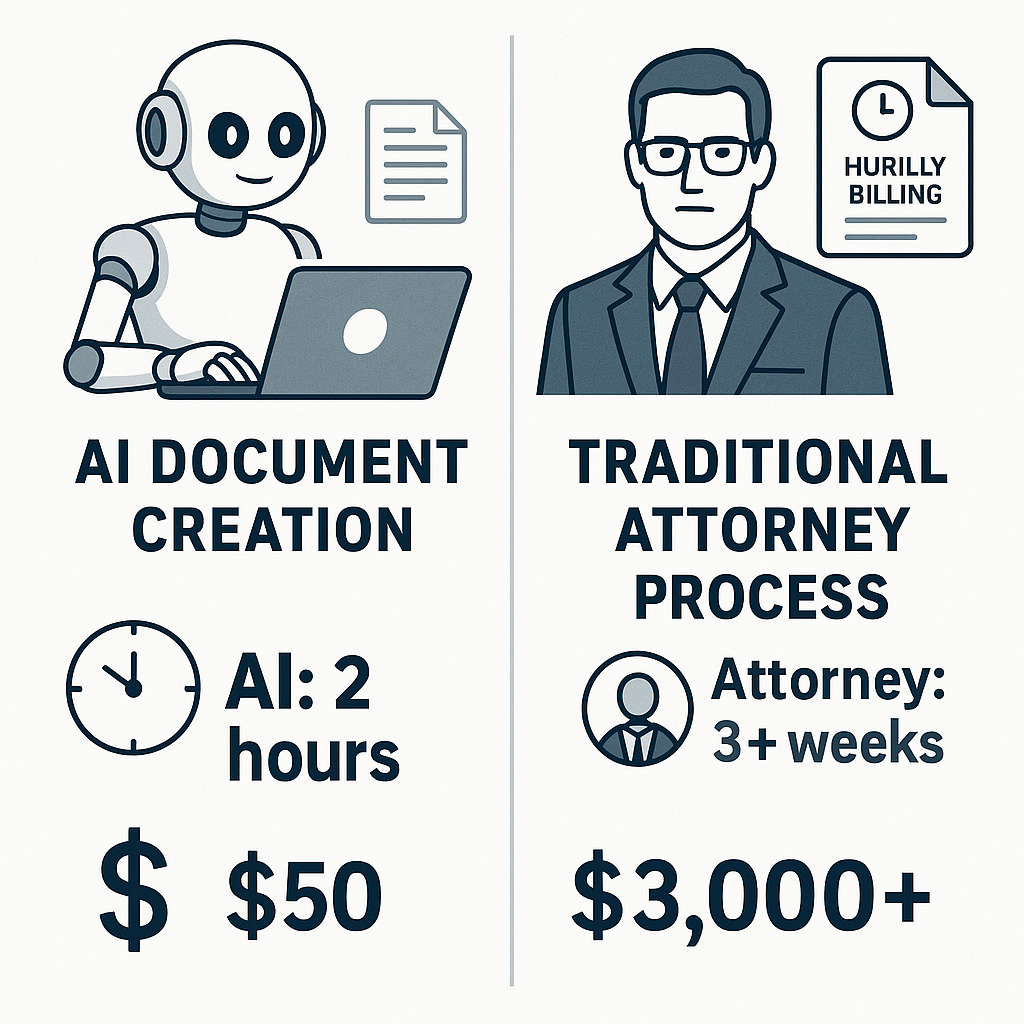
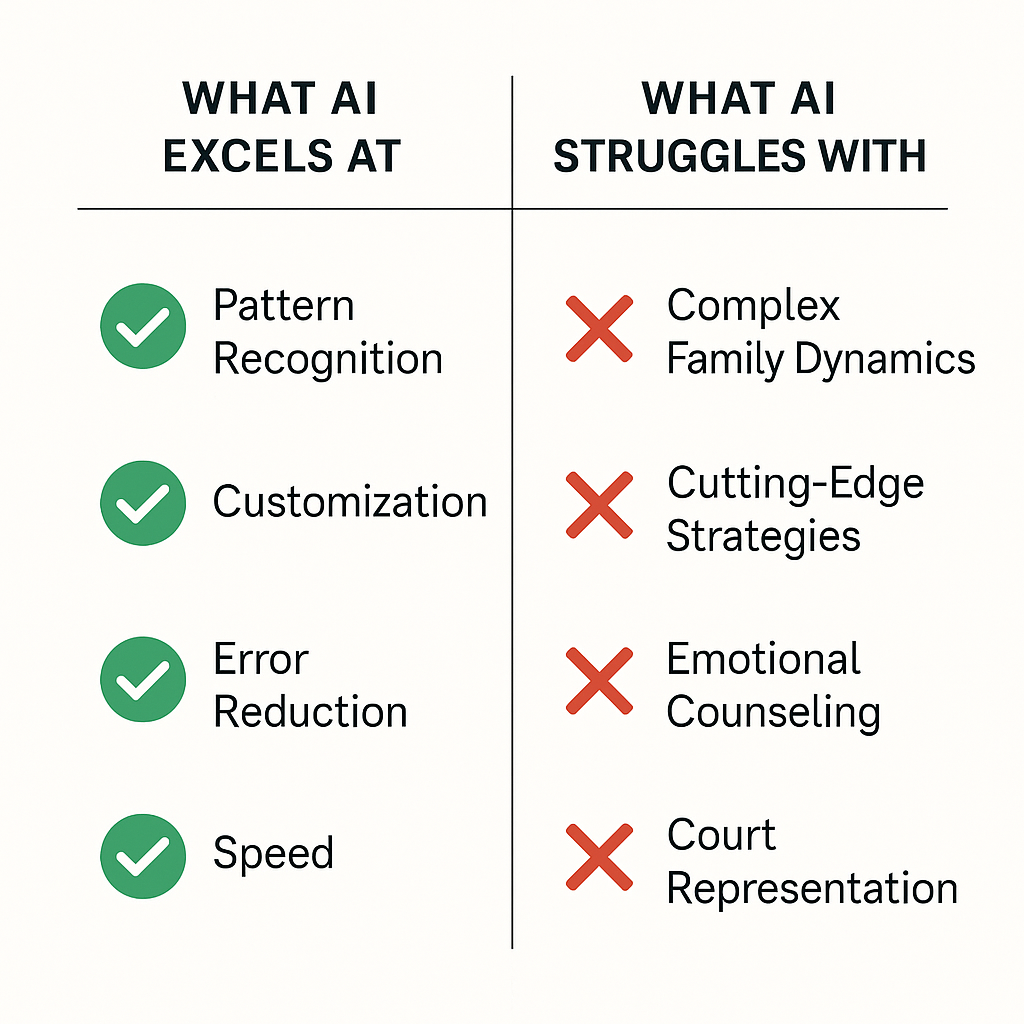
Here’s what’s revolutionized estate planning: AI can now create professional-quality living trusts for a fraction of attorney costs.
Traditional approach:
•Schedule attorney consultation (2-4 weeks wait)
•Pay $400/hour for 3+ hours
•Wait 2-3 weeks for document preparation
•Total cost: $3,000-$6,000
•Total time: 4-6 weeks
AI-assisted approach:
•Use proven prompts (start immediately)
•Generate customized documents (2-4 hours)
•Optional attorney review ($300-$500)
•Total cost: $50-$500
•Total time: 1-2 weeks
Same legal protection. 90% less cost. 75% faster.
Real Family Scenarios: Trust vs Will
[IMAGE: Four different family types with their recommended solutions]
Scenario 1: Young Couple, First Home
Assets: $350K house, $75K savings, $200K retirement accounts Recommendation: Living trust Why: House alone makes probate expensive and time-consuming
Scenario 2: Single Parent, Minor Child
Assets: $180K condo, $50K savings, $150K life insurance Recommendation: Living trust (essential) Why: Minor children can’t inherit directly; trust provides management
Scenario 3: Blended Family
Assets: $500K house, $300K investments, adult children from previous marriages Recommendation: Living trust (critical) Why: Prevents conflicts between current spouse and children from previous marriage
Scenario 4: Business Owner
Assets: $200K business, $400K real estate, $100K equipment Recommendation: Living trust (mandatory) Why: Business continuity requires immediate successor control
The Decision Framework
[IMAGE: Decision tree flowchart]
Ask yourself these questions:
1.Do I own real estate? (If yes → Living Trust)
2.Are my assets worth more than $100K? (If yes → Living Trust)
3.Do I have minor children? (If yes → Living Trust)
4.Do I want privacy for my family? (If yes → Living Trust)
5.Do I want to avoid probate delays? (If yes → Living Trust)
If you answered “yes” to ANY question, you need a living trust.
How to Get Started (The Smart Way)
[IMAGE: Step-by-step process graphic]
Option 1: Traditional Attorney Route
Cost: $3,000-$6,000 Time: 4-6 weeks Pros: Full service, local expertise Cons: Expensive, slow
Option 2: AI-Assisted Creation
Cost: $50-$500 (with attorney review) Time: 1-2 weeks Pros: Affordable, fast, customized Cons: Requires some effort on your part
Option 3: Hybrid Approach (Recommended)
Cost: $500-$1,000 Time: 2-3 weeks Process:
1.Use AI to create initial documents
2.Have local attorney review and refine
3.Get professional guidance on funding
4.Best of both worlds
Your Complete Living Trust System
[IMAGE: Book cover “Create Your Living Trust Using AI” with bonus materials]
Ready to protect your family the smart way?
My complete system “Create Your Living Trust Using AI” gives you everything you need:
✅ 50+ proven AI prompts for every family situation ✅ State-by-state requirements for all 50 states ✅ Will vs trust decision guide (know exactly what you need) ✅ Step-by-step funding instructions (the critical part most people miss) ✅ Professional worksheets to organize your information ✅ Real examples of completed trusts ✅ Attorney review guidelines for peace of mind
Investment: $47 (less than one hour of attorney time) Potential savings: $15,000-$100,000 in probate costs Peace of mind: Priceless
The Bottom Line Decision
[IMAGE: Family protection comparison showing “WILL = RISK” vs “TRUST = PROTECTION”]
If you want to just check a box: Get a will.
If you want to actually protect your family: Get a living trust.
The choice is yours. But remember—your family has to live with the consequences.
Don’t let your family become another probate horror story.
Take Action Today (Your Family is Counting on You)
[IMAGE: Urgency graphic with “PROTECT YOUR FAMILY NOW”]
Every day you wait is another day your family is at risk.
If something happened to you tomorrow:
•Could your spouse access your bank accounts immediately?
•Would your house be tied up in probate for months?
•Would your family’s private financial information become public?
•Would they have to spend thousands on legal fees during their time of grief?
With a will: The answer to all these questions is probably “yes.”
With a living trust: The answer is “no”—your family is protected.
[GET YOUR COMPLETE LIVING TRUST SYSTEM HERE →]
P.S. Still not sure which option is right for you? Take my free 2-minute quiz that analyzes your specific situation and tells you exactly what you need. No email required, instant results.
[TAKE THE QUIZ NOW →]
What’s your biggest concern about choosing between a will and living trust? Drop a comment below and I’ll give you personalized advice.
Because your family’s protection can’t wait for “someday.”